No One Else’s Words: Holding Space for First-Person Truth in Dementia Care
At the UK Dementia Congress 2025, I shared reflections from a project that shifted how I think about reminiscence, voice, and truth in dementia care.
Alongside fellow practitioner Janet Costley, I led an exploratory Remembering Yesterday Caring Today (RYCT) project that asked a simple question:
What happens to creative reminiscence when a person tells their story alone?
This work has stayed with me, not because it offered neat answers, but because it challenged assumptions about memory, accuracy, and whose voice we privilege in dementia care.
Project Background
For those unfamiliar with RYCT, developed internationally 1997 and led by Pam Schweitzer MBE, it is a structured reminiscence programme for people living with dementia and those close to them (often the primary care partner). Sessions explore the life course through creative activities, supporting couples to reconnect with shared histories while also offering care partners their own space for peer support, reflection, and skills-building.
It’s a model deeply rooted in relationships - often working with people at moments of intense stress, transition, and isolation.
But with an estimated 120,000 people in the UK living with dementia alone, a figure expected to double by 2040, we wanted to ask:
What does reminiscence look like when there is no care partner present?
How do we hold someone’s story when there is no shared memory to draw on?
And what kinds of truth emerge when no one is there to correct, clarify, or fill in the gaps?
This project explored a potential new approach to sit alongside the existing RYCT model - working one-to-one with people living with dementia, supported by volunteers, but without a family member or care partner present.
Working Without the Safety Net of Shared Memory
This solo approach often began with very little, sometimes just a name, or birthplace.
Rather than filling the space with questions, we focused on listening first - allowing silence, observation, and intuition to lead. We paid attention to small things, a glance towards a photograph, a smile during a piece of music, a comment so brief you could almost miss it.
It is slow work, slower than most group settings allow. But in that slowness, something important happens. People begin to lead, in their own time.
The focus shifts away from gathering “accurate” facts and towards creating the conditions where a person’s voice, their tone, rhythm, and way of remembering, can emerge.
This approach requires trust:
between facilitator and participant
between memory and imagination
between what is remembered and what is felt
And it asks us, as practitioners, to sit with uncertainty rather than rush to resolve it.
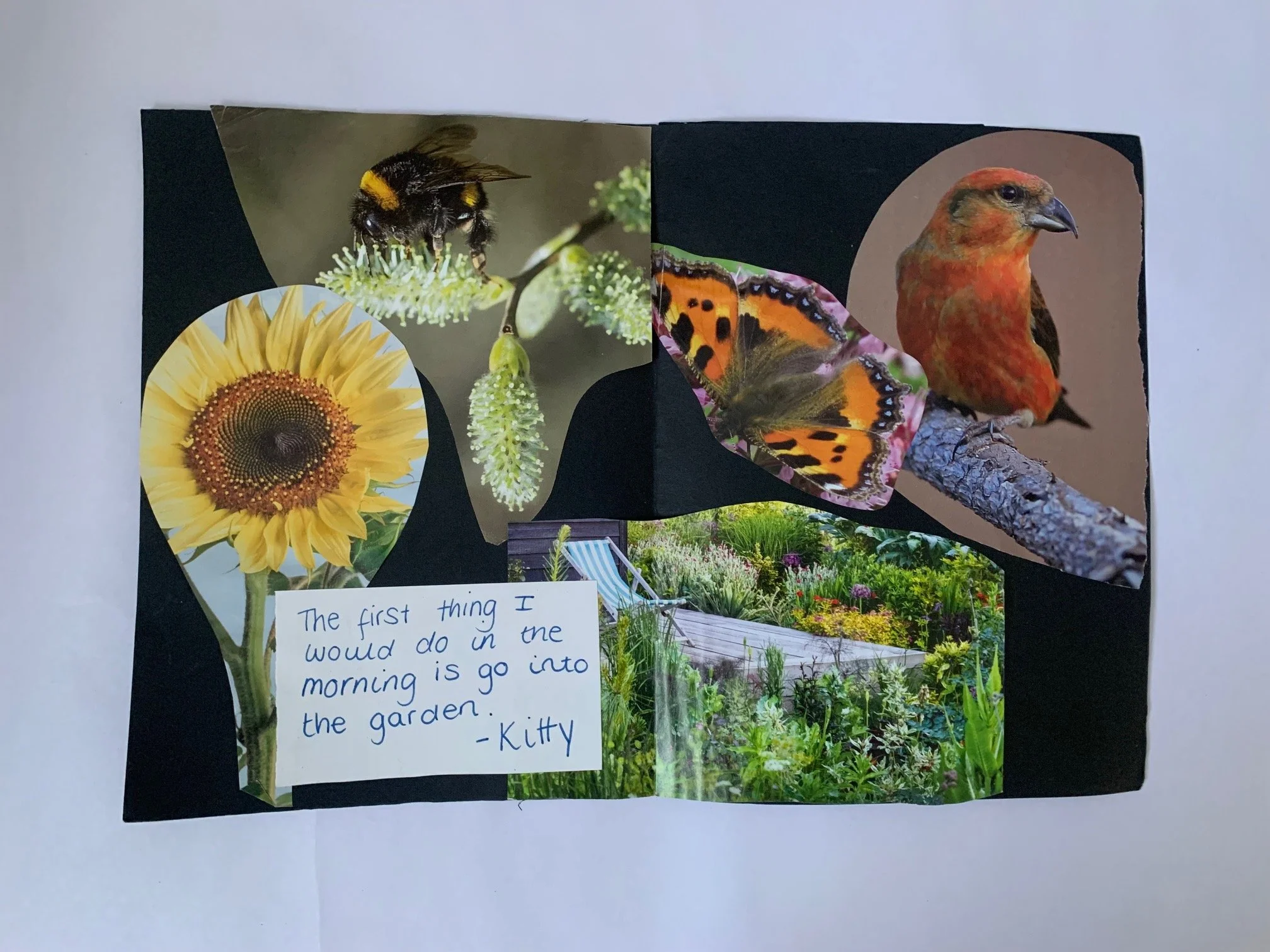
Michael: A Life Re-emerging in Fragments
Michael, who attended a memory hub with a professional carer and had no known family, was initially quiet and unable to recall specific childhood memories. Rather than pushing, we followed small cues — his interest in a toy plane and a brief mention of a London high street. Using these fragments, photographs triggered recognition and memories of wartime London, his family, work, and languages he once spoke. Over four sessions, these moments grew into a rich, nine-page life story - not verified for accuracy, but alive and his own.
What Michael’s experience reminded us is reminiscence isn’t about confirming facts. It’s about rediscovering a sense of self that may have gone quiet. The value lies not in historical accuracy, but in the experience of being heard on one’s own terms.
Gloria: When a Story Finally Finds Somewhere to Rest
Gloria’s story showed how creative reminiscence can create space for difficult emotions. Gloria often repeated the painful memory of losing a child, a loss family found difficult to talk about. It arose a number of times during the first session, but by listening without rushing or redirecting, her grief was fully acknowledged. Over time, the repetition eased, suggesting the memory had found a different place to rest. Volunteers noted the significance of this shift, and later Gloria’s family was deeply moved by her life story book - showing how her solo reminiscence also strengthened connection beyond the sessions.
It was a powerful reminder that even when stories are told alone, their impact can ripple outward in unexpected ways.
First-Person Truth
Michael and Gloria’s experiences were very different, but together they revealed something vital. When we work without a care partner, we lose a certain kind of context, there are gaps we can’t fill, stories trail off and sometimes timelines blur.
But we also gain something: the person’s own framing of their life, without interruption, correction, or external narratives.
This requires facilitators to let go of the urge to tidy, verify, or explain. It asks us to witness what is being shared, even when it’s incomplete, contradictory, or purely emotional, because those fragments still hold important truths.
I’ve come to believe that accuracy and truth are not always the same thing. Accuracy belongs to facts. Truth belongs to experience, to how someone feels and remembers in the present moment. When we privilege first-person truth, we affirm that a person’s current sense of self still matters, even as memory changes.
A Rights-Based Practice
At its heart, this way of working is rights-based. It protects autonomy and personhood, especially when cognitive abilities are shifting. Creative reminiscence becomes more than an activity, it is an act of recognition and personhood- you are still the author of your own story.
In practice, this means:
creating space for unfiltered expression
resisting the urge to overwrite or interpret on someone else’s behalf
holding uncertainty with care
It’s less about producing a polished life story book, and more about cultivating the conditions where a story can happen, however it appears.
What This Has Changed for Me
Working alongside Janet, whose practice brings reminiscence into end-of-life care, reinforced something fundamental: listening is not passive. It is an active, creative, and deeply ethical process.
This project also made me more aware of how the structures around reminiscence shape whose voices are heard. For people without family or partners, the solo approach offers inclusion and a way to be seen as an individual, not only in relation to others.
This isn’t so much a new model as an invitation - to slow down, to listen differently, and to hold stories with openness rather than certainty. When we do, we discover that even the smallest fragments can carry extraordinary meaning.
Because every person, wherever they are in their dementia journey, deserves the dignity of being heard in their own words and no one else’s.
